
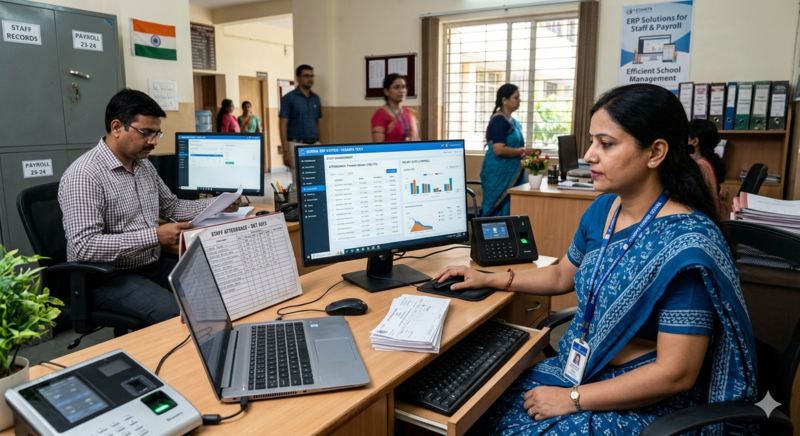
How a School ERP Helps Schools Manage Staff Attendance, Salary, and Payroll
In today’s fast-paced education environment, schools are no longer relying only on paperwork and spreadsheets to manage daily operations. From tracking teacher attendance to processing salaries on time, educational institutions need smarter and more efficient systems. This is where a School ERP (Enterprise Resource Planning) system becomes essential.
A School ERP helps schools automate administrative tasks, improve accuracy, save time, and create a smoother workflow for management, teachers, and staff.
What is a School ERP?
A School ERP is a centralized software platform designed to manage and automate various school operations. It connects departments such as administration, HR, finance, academics, transport, and communication into one unified system.
With a School ERP, schools can easily manage:
- Staff attendance
- Salary and payroll processing
- Student records
- Fee collection
- Timetables
- Leave management
- Communication with parents and staff
Among these features, staff attendance and payroll management are some of the most valuable benefits for school administration.
1. Staff Attendance Management Made Easy
Managing staff attendance manually can be time-consuming and prone to errors. A School ERP automates the entire process and provides real-time tracking.
Key Features of Attendance Management
Biometric and Digital Attendance
Teachers and staff can mark attendance through:
- Biometric devices
- Mobile apps
- RFID cards
- Web login systems
This reduces fake entries and ensures accurate records.
Real-Time Monitoring
Administrators can instantly check:
- Present staff
- Absent employees
- Late arrivals
- Half-day records
Leave Management Integration
Employees can apply for leave directly through the ERP portal. The system automatically updates attendance records after approval.
Attendance Reports
School management can generate:
- Monthly attendance reports
- Leave summaries
- Working hour reports
- Late-coming analysis
These reports help improve discipline and workforce planning.
2. Simplified Salary Management
Salary calculation becomes complicated when schools manage multiple employees with different pay structures. A School ERP simplifies the entire process.
Benefits of Salary Management in School ERP
Automated Salary Calculation
The ERP automatically calculates salaries based on:
- Attendance records
- Working days
- Overtime
- Leaves
- Bonuses and deductions
Error-Free Processing
Manual payroll errors can lead to staff dissatisfaction. Automation reduces calculation mistakes and ensures accurate salary distribution.
Custom Salary Structures
Schools can create different salary structures for:
- Teachers
- Administrative staff
- Support staff
- Part-time employees
Salary Slip Generation
The system automatically generates digital payslips that employees can download anytime.
3. Efficient Payroll Processing
Payroll management involves taxes, deductions, compliance, and timely payments. A School ERP streamlines these complex tasks.
How ERP Improves Payroll Management
Automated Tax and Deduction Calculations
The system automatically manages:
- PF deductions
- Professional tax
- Income tax
- Insurance deductions
Direct Bank Transfer Integration
Many ERP systems integrate with banking systems for seamless salary transfers.
Compliance and Record Keeping
Payroll records are securely stored for audits and compliance purposes.
Faster Payroll Cycles
Schools can process payroll within minutes instead of spending days on manual calculations.
4. Improved Transparency and Accountability
A School ERP creates transparency between management and employees.
Staff members can:
- View attendance records
- Download salary slips
- Check leave balances
- Track payroll history
This reduces confusion and improves trust within the organization.
5. Time and Cost Savings
Manual HR and payroll operations consume significant time and resources. By automating these processes, schools can:
- Reduce paperwork
- Minimize administrative workload
- Cut operational costs
- Improve productivity
The administration can focus more on academic excellence rather than repetitive administrative tasks.
6. Better Decision-Making Through Reports
School ERP systems provide detailed analytics and reports that help management make informed decisions.
Examples include:
- Staff performance trends
- Payroll expense analysis
- Attendance patterns
- Department-wise salary reports
These insights help schools plan budgets and manage human resources effectively.
7. Enhanced Data Security
Employee records and payroll information are sensitive. School ERP systems provide:
- Secure cloud storage
- Role-based access
- Data backup
- Encrypted information handling
This ensures confidential information remains protected.
Conclusion
A School ERP is more than just management software — it is a complete digital solution that transforms school administration. By automating staff attendance, salary calculation, and payroll processing, schools can improve efficiency, reduce errors, and save valuable time.
As educational institutions continue to adopt digital technology, implementing a reliable School ERP system is becoming a necessity rather than an option. Schools that embrace ERP solutions can create a more organized, transparent, and productive working environment for both staff and management.
Investing in a School ERP today means building a smarter and more efficient school for the future.